😣 The pain was so intense I almost cried on the operating table. Finally, I realized that what’s most intimidating about the Ulthrea isn’t its price at all.
Before doing it, what I was most afraid of wasn’t actually the pain.
It’s a sunken face.
Because my face isn’t naturally the type with a lot of flesh.
What I’d like to improve is the appearance of my lower face, which doesn’t look as defined as it used to. Especially when taking photos, I feel like my jawline isn’t as sharp as before.
That’s why I initially wanted to try the Ulthrea—my idea was actually quite simple:
It’s not about making the whole face shrink suddenly; I just want the contours of the lower face to look neater.
But before I finally decided to go to South Korea for the procedure, I kept hesitating.
I’ve seen many people share their experiences with HIFU — some say it works really well, while others keep emphasizing how painful it is.
What really matters to me is something else:
What if my face isn’t naturally plump, and in an effort to define my jawline, it ends up making my face look sunken instead?
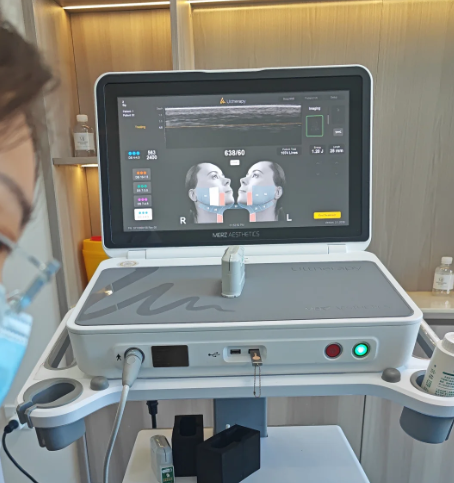
So after lying down on the treatment table this time, I kept staring at the screen almost the whole time.
It hurt so much I almost cried, but all I could think about was:
“Where should this shot be aimed?”
“Why this location?”
“Will this really give me the results I’m looking for?”
This time, we’re not talking about those stories of instantly looking like a young girl right after the procedure.
I want to document everything about this experience — why I decided to do it, the consultation, when the actual injections started, how painful it was, what to expect on the day after the procedure, and how to monitor my jawline over time.
If you’re currently searching for questions like “Does the Ulthrea used in South Korea hurt?” “Will using the Ulthrea cause my face to sink?” or “Will my jawline become more defined?”, this is exactly the kind of information I would have loved to see before getting it done myself.

⚡ Quick answer: Is the Ulthrea used in South Korea really painful? My answer is “It definitely hurts.”
Let’s answer directly first.
It hurts.
And it’s not the kind where “it’s a little stimulating and you can just hold on.”
This time, I have a few areas where the pain is really noticeable. When I reach certain spots, there are moments when I actually wonder:
“How much longer?”
But after having it done, I no longer equate “more pain” with “better results.”
Because what really matters to me is:
Why did the doctor choose this location?
Is my face shape actually suitable?
Do I want to address sagging, or do I just want my face to look smaller?
Especially for those who already have a thinner face, I think these issues are more important than simply focusing on hair volume.
So if you ask me one question:
Is it worth getting the Ulthrea?
I won’t directly answer whether it’s worth it or not.
I’d say:
First, figure out exactly what needs improvement on your face, then decide on the best course of action.
Book an appointment for the Ulthrea in South Korea now!
🪞 What I really want to improve this time isn’t a “smaller face,” but my jawline.
Before, when I saw before-and-after photos of cosmetic procedures, I often mistook “a smaller face” for “sharper facial contours.”
Only after doing it once now did I realize it’s completely different.
What I really want is:
The lower half of the face looks neater.
Especially at a 45-degree angle and from the side.
It’s hard to tell just by looking at a front-facing photo sometimes.
But as soon as the camera angle shifts even a little, I start paying attention to my jawline.
Things I didn’t used to pay much attention to now keep catching my eye.
That’s why my goal for this time is very clear:
Don’t aim to shrink the entire face—just focus on whether the jawline looks cleaner.
This goal has continued to influence the way I view the entire treatment process ever since.
Because if in the end it only makes my face slimmer but eliminates the already limited fullness I have, I won’t be satisfied at all.
😰 Just before I actually lay down on the treatment bed, I suddenly started to regret it.
When looking up information earlier, you might think:
“Isn’t it just one treatment session?”
Once you’re actually on the treatment bed, your mindset is completely different.
Because at that moment you’ll be absolutely clear:
From now on, all the effort really needs to be put into my face.
What scares me the most is especially a sunken face.
So as the doctor started getting things ready, one thing kept repeating in my mind:
Don’t make my skin too dry just to define my jawline.
Looking back now, it was actually the first time I truly realized this as well:
When it comes to medical aesthetics, you can’t just focus on package deals.
Just because you see others doing hundreds of shots doesn’t mean you should do the same.
Just because you see someone get a full facial doesn’t mean you need one too.
What really needs to be clarified first is:
Which specific issue do you want to improve?
👀 Why was I staring at the screen the whole time? Because I’m really terrified of my face getting sunken.
To be honest, I’m not expert enough to fully understand every parameter on the screen.
But I just can’t help looking.
Because I want to know if the doctor made adjustments based on my condition.
Instead of:
“That’s the package for today—everyone goes through the same process.”
There’s a huge psychological difference.
When you know what you fear the most, you pay extra attention to it.
What scares me is a sunken face.
So from start to finish, I kept paying attention the whole time:
Where is the procedure being done?
Has it always been focused on the areas I care most about?
Did the doctor make any adjustments based on my face shape?
This is also why I now believe that before getting the procedure, you must clearly communicate to your doctor what “the very last thing” you want to happen.
Don’t just say:
“I want to look beautiful.”
This sentence is actually too vague.
If your face is already relatively thin, you can simply say:
“What worries me the most is sagging cheeks. I hope my jawline can improve, but I don’t want my whole face to look drier.”
At least the doctor knows your priorities.
😭 As soon as Seoulcheil released it, I almost burst into tears.
Once it actually got started, my first reaction was:
It hurts.
And it’s not just in your head.
In some areas, when you apply pressure, you’ll feel a very intense deep-level stimulation.
Especially when you know the next one is coming soon, the psychological pressure can be quite intense.
I would even count down in my head at that time.
One shot.
Hold on a second.
One more shot.
Then I thought to myself:
“Okay, hold on a bit longer.”
The worst part isn’t just the pain for a single time.
It’s more like you know this process isn’t over yet.
So before getting an Ulthrea treatment, if anyone asks me:
“Is it really painful?”
I won’t talk to him anymore:
“It’s okay, just hold on a bit longer.”
Because everyone experiences pain differently.
But at least from my experience this time:
It’s definitely not a treatment that can be done with zero discomfort.
Book an appointment for the Ulthrea in South Korea now!
🥲 At the worst moment, I was even thinking, “Is it really necessary to get this done here?”
Looking back on it now, it’s quite funny.
Because when the pain was almost unbearable, I was still staring at the screen.
Before, I might have thought:
“It hurts this much already—it must be pretty effective, right?”
I wouldn’t think that way now.
Pain and results aren’t necessarily equivalent.
Similarly:
Higher volume of treatments doesn’t necessarily mean better results.
Because the real issue is:
Where exactly is this energy being used?
Why is it used here?
Does it suit my face shape?
This is the biggest shift in my mindset after going through this procedure.
🪞 On the day after the procedure, I didn’t feel like I suddenly had a V-shaped face.
If what you’re hoping for is:
“Look in the mirror right after the procedure — your chin line will be clearly visible.”
I think you might be disappointed then.
What came to mind right after I finished it was actually:
Don’t rush to judge just yet.
I started looking at my own face.
Look at the front side.
Look at 45 degrees.
Look at the side.
Then I started to worry:
“Was it a bit swollen somewhere just now?”
“Does it look sunken here?”
“Is it just the lighting?”
After getting cosmetic procedures, it’s really easy to keep staring at your face.
After looking at it for too long, even you start to doubt yourself.
So I decided later on:
Don’t base your decision on how you feel right now.
Just take a photo.
And try to keep it consistent:
Same angle.
The same glow.
The same expression.
No filters.
Don’t deliberately lift your chin.
Only then can we truly make a comparison.
📅 Day 0: What matters most to me isn’t looking beautiful—it’s making sure there aren’t any issues that scare me the most.
That night, I wasn’t actually thinking about it the whole time:
“How much smaller by centimeters?”
What really matters to me is:
Is the condition of the face normal?
Because for me, what matters most this time is not achieving an overly drastic transformation.
Rather than:
Improve the jawline without compromising the overall face shape.
So I started setting a very simple criterion for myself:
What I want to see
The contours of the lower face are more defined.
I don’t want to see it.
My cheeks suddenly became very dry and sunken.
I’ll look at these two things together.
rather than focusing solely on “whether it gets smaller.”
📅 Day 3: I started shifting my focus from “results” to “recovery”
It wasn’t until Day 3 that I started to realize another issue:
If you go to South Korea for cosmetic procedures, the recovery period is actually extremely important.
Because many people don’t live in South Korea.
It might only be scheduled for a few days.
After the procedure, there’s still time for shopping, dining, taking photos, and heading back home.
So whether a treatment course is right for you depends not just on the results.
Also check out:
Can I handle its recovery process?
This is something I never paid attention to at all when looking at price lists before.
I used to only look at:
How much?
How many shots?
Now there’s one more thing to keep an eye on:
Will my daily life be affected in the days after the procedure?
📅 Day 7: I started paying closer attention to my chin line.
It wasn’t until after the first week that I felt more confident in making judgments.
But I wouldn’t just take a selfie with my phone and jump to conclusions.
I’ll compare them with the pre-op photos.
Check out especially:
Positive side.
45 degrees.
Side view.
What matters most to me is the contour of the lower face.
Because that’s exactly why I started this treatment in the first place.
Instead of:
“Has it turned into a ‘internet celebrity face’?”
I think this difference is really important.
Because if you don’t set clear goals from the start, it’s easy for things to turn out like this in the end:
I wanted to refine my jawline before getting the procedure.
After the procedure, I kept wondering why I didn’t have a small triangular face.
That’s actually no longer the same goal.
📅 Day 14: I started to understand that “a clearer jawline” doesn’t necessarily mean “a smaller face overall”.
This is the concept that struck me the most this time.
Before, when I saw before-and-after photos of others, it was easy for me to jump to conclusions right away:
“Her face looks smaller.”
But now I’ll take a look first:
Is it actually the case that the lower jaw line is quite distinct?
Is the side profile cleaner?
Is it just that the shadows have become more noticeable?
Because sometimes, just having clearer contour lines can make the face appear smaller visually.
But a wider face doesn’t necessarily change that much in reality.
So if your goal is also to define your jawline, I think you shouldn’t consider “face slimming” as the only criterion.
Book an appointment for the Ulthrea in South Korea now
📅 Day 30: What’s truly worth seeing is comparing before and after photos
It’s only at this stage that I feel I can seriously look back.
Because in the days right after the procedure, it’s really easy for one’s mental state to be affected.
I feel like I look prettier today.
Tomorrow I’ll think again:
“Is it really no different?”
All of this is completely normal.
So in the end, I went back to the most basic method:
Pre-surgery photos.
Photos now.
Same angle.
Same as glow.
Same expression.
Look at them together.
Only then can we answer more accurately:
“Has the issue I really wanted to improve actually seen any improvement?”
Instead of keeping asking:
“Have I turned into a different face?”
🔍 After going through it, I actually stopped believing in the so-called “fate numbers” anymore.
If you ask me now:
“How many shots are ideal for the Ulthrea?”
I really can’t give you a fixed answer.
Because the question itself is a bit strange.
You should ask first:
Where do you want to have it done?
What’s the shape of your face?
What’s the main issue?
How much does the doctor determine needs to be treated?
Decide on the treatment plan again.
So now, when I see numbers like “500 shots,” “600 shots,” and “800 shots,” I don’t immediately think:
“Wow, this one is more cost-effective.”
I’d ask first:
Where do I enter these codes?
What equipment is used?
What probe should be used?
Who’s operating it?
What’s included in the price?
That’s how it makes sense to compare.
💰 What should you consider when looking at the price of Ulthrea in South Korea? Don’t just focus on the “lowest price”
Regarding prices, I’ll break it down for you now.
That’s because there’s no fixed answer to “how much does the Ulthrea cost” that applies to all clinics.
When looking at publicly available information on medical aesthetics in South Korea, it’s clear that there are significant price differences among various treatment volumes and different body areas. Therefore, when you see prices as low as several hundred thousand won, you shouldn’t immediately compare them with the full treatment package offered by another clinic.
What really needs to be aligned is:
Equipment.
Probe.
Send the number.
Treatment area.
Doctor.
Whether tax is included.
Are there any other fees?
If these elements aren’t aligned, simply comparing prices doesn’t really make sense.
If I were to rearrange it now, I would first gather all this information clearly before making a decision.
🇰🇷 If you’re planning to get procedures in South Korea too, I’ll ask you these 8 questions first.
This is the part I find most useful after I’ve finished it.
Ask directly before going:
1. I mainly want to improve my jawline — which areas actually need to be treated?
2. My face is relatively thin—which areas are not recommended for excessive treatment?
3. What specific equipment was used this time?
4. Which probes/deepnesses to use?
5. How many sessions will actually be scheduled?
6. Will the doctor conduct a preliminary consultation before deciding on the injection method?
7. What does the quote include?
8. How much recovery time do I need to schedule for my trip to South Korea after the procedure?
I actually think now that these 8 questions are better than keeping asking:
“Is your family really famous?”
More useful.
If you’ve already decided on the treatment you want, I’ll first organize all these details, and then we can confirm the hospital, treatment plan, and date of departure to Korea by adding me on WeChat: s-sourire. This way, you won’t have to realize at the last minute that what you thought you were getting wasn’t actually what’s available.
Book an appointment for the Ulthrea in South Korea now
⚠️ For those with a relatively thin face, I actually recommend not copying someone else’s treatment plan verbatim.
This is the one thing I want to emphasize most after I’ve done it.
If you already have a relatively thin face, when you see others’ chins looking more defined after treatment, you might immediately think:
“I want to be like her then.”
I think we should wait.
Because the faces of the two of you might be completely different.
She might have a higher body fat percentage.
You might just have less fat to start with.
Her main issue is likely sagging.
You might actually be a skeletal outline.
The final areas that need to be addressed will, of course, not be exactly the same.
So if your biggest concern is a sunken face, be sure to mention it right away during the in-person consultation.
Don’t worry about it by yourself in silence.
And definitely don’t keep asking for more sessions just to achieve a “more powerful effect.”
❓ Is the Ulthrea really that painful?
Based on my own experience this time:
It really hurts.
Moreover, the pain in some areas is quite noticeable.
But everyone feels differently, so don’t take my pain as your own.
Don’t assume it must work just because others say it’s “extremely painful.”
❓ How long does it take to see results?
I don’t recommend judging based solely on the appearance right after the procedure.
If I really want to examine the jawline, I would observe it for a while using photos taken at a fixed angle.
Pre-surgery, Day 7, Day 14, and Day 30 — that makes more sense.
❓ Can it be done if my face is relatively thin?
It’s not simply determined by whether it’s “slim” or “not slim.”
What’s more important:
What do you want to improve?
If the main issue is sagging, you can ask the doctor to determine whether it’s suitable.
If you simply feel that your face is too large, don’t rush into getting an HIFU treatment just because people assume it helps slim the face.
❓ Is it true that the more posts you make, the better?
No.
The number of sessions is just part of the treatment protocol.
It can’t be considered in isolation from the specific area, face shape, treatment goals, and the doctor’s assessment.
❓ Can using the Ulthrea cause sagging in the face?
I can’t guarantee to you that “it definitely won’t happen.”
If you already have a relatively thin face and are very concerned about hollows, the most important thing is to share this concern with your doctor before the procedure to ensure that the treatment area and plan are suitable for you.
❓ Can you see the jawline right after the procedure?
Don’t take what you see on the day as the final result.
If you really want to assess the results, taking photos at a fixed angle and observing over time is far more meaningful than constantly looking in the mirror on the same day.
❓ Is the Ulthrea the same as radiofrequency lifting?
They’re not the same treatment regimen.
Although both are often discussed in relation to firming, contouring, and anti-aging, they use different forms of energy and treatment methods.
So if you’re choosing between HIFU and radiofrequency therapy, you should start by identifying your main concerns, rather than just focusing on which one is more popular.
🪞 If I had to choose again right now, would I do it?
I can’t say it in one sentence right now:
“It’s worth it.”
Or:
“It’s not worth it.”
Let’s answer.
After going through this once, I actually think this issue is way too simple.
I start by asking myself:
What is it I really want to improve right now?
If you just want a cleaner jawline, I’d first check to see if it’s right for me.
If I already have a thin face, I would put “avoid over-treatment” right at the top.
If I were to go to South Korea, I’d also take the recovery time into account along with my itinerary.
rather than just looking at:
“How much is this one?”
“How much for a few hundred of these?”
“Don’t people get super small faces after having it done?”
Book an appointment for the Ulthrea in South Korea now!
💭 After going through this experience, what stayed with me in the end wasn’t the idea that “HIFU is amazing,” but rather a much more practical thought.
In the past, when choosing cosmetic procedures, I was easily drawn to the word “results.”
When I see someone else’s beautiful jawline, I think:
I want one too.
But after actually doing it myself once, I started to think:
What exactly am I looking for?
Do I want my face to look smaller?
Actually, it’s not.
I want the lower half of my face to not look so loose.
I want a cleaner contour when taking photos.
I want to look refreshed, not have a completely new face.
So if anyone asks me now:
“What should you pay the most attention to before going to South Korea for an Ulthrea treatment?”
I’ll answer:
Don’t ask yourself how many shots you need first.
Let’s start with a question:
“What exactly needs improvement on my face?”
Then decide on the equipment, probes, number of sessions, treatment areas, and budget.
This is also something I truly learned this time.
If you’ve already decided to get the procedure in South Korea, make sure not to start asking these questions once you’re there. First, clarify your own requirements and biggest concerns, then finalize the treatment plan. When it’s time to schedule an appointment, I’ll discuss all the details through WeChat at s-sourire before we decide whether to go ahead with the procedure.
As for me?
I no longer think a treatment is better just because it involves “hundreds of shots.”
What really matters to me is:
Are these treatments actually targeting the areas I really need? All content on this site adheres to the principle of helping people avoid pitfalls in medical aesthetics — for more details, see our About page.